If you’re asking Why USD/CAD Is Important, UsdCadCurrency explains it clearly: the pair’s link to US–Canada trade, oil dynamics, inflation and rates, and the practical impact on businesses, travelers, students, and traders.
Quick Answer — Why USD/CAD Matters in One Minute
The nutshell
USD/CAD reflects US–Canada trade flows, oil price dynamics, and interest-rate differentials—affecting import costs, travel, tuition, e-commerce, salaries, and investing.
Table of Contents
The Economic Backbone — How USD/CAD Connects Two Economies
Trade & supply chains (auto, energy, agriculture, services)
Pricing imports/exports — pass-through to consumer & producer prices
USD/CAD is a pricing fulcrum for cross-border goods. When USD/CAD rises (CAD weakens), Canadian importers pay more CAD for USD-priced inputs (machinery, components, software), which lifts producer prices and later consumer prices. When USD/CAD falls (CAD strengthens), imported inputs get cheaper, easing cost pressures and sometimes retail prices.
Pass-through is not instant or 1:1. It depends on: (1) contract currency and hedging coverage, (2) competitive pressure in the end market, (3) inventory cycles, and (4) how frequently prices are updated. Auto and machinery see faster pass-through because components are heavily USD-denominated; food and retail can lag due to catalog pricing and promo calendars.
Use case: a Canadian importer with thin margins may pre-hedge quarterly USD needs and stagger price updates to smooth FX shocks. Exporters billing in USD may keep USD list prices stable while translating profits back to CAD, making results very sensitive to USD/CAD.
Cross-border invoicing — why many contracts are USD-denominated
Despite dealing with Canada, many suppliers quote in USD because it is (a) globally liquid, (b) standard for commodities and high-value equipment, and (c) reduces their own FX ops. This pushes FX risk onto the Canadian buyer unless the buyer insists on CAD pricing or embeds a currency clause.
Practical patterns you’ll see:
- USD unit pricing with periodic FX true-ups.
- Dual-currency quotes (USD/CAD) where the supplier bakes an FX buffer into the CAD number.
- Commodity surcharges pegged to USD benchmarks (e.g., steel, energy).
Internal reference: Import/Export guide → /guides/import-export-usd-to-cad/
Investment & FDI
Currency risk in cross-border M&A and capex
For acquirers and multinationals, USD/CAD shifts can change deal valuation, purchase price adjustments, and post-merger returns. A stronger USD inflates CAD-translated liabilities and operating costs tied to USD (royalties, software licenses), while a stronger CAD can depress the translated value of USD earnings.
For greenfield capex, location decisions weigh: (1) expected USD/CAD range, (2) input currency mix (energy, parts, payroll), and (3) revenue currency. Firms with USD revenues + CAD costs may benefit from a weaker CAD (natural hedge), whereas CAD-revenue businesses importing USD inputs face margin compression when USD strengthens.
Hedging policies for treasury teams (forwards, options)
A written FX policy usually defines:
- Exposure mapping: forecast USD inflows/outflows by month/quarter.
- Hedge ratios by tenor: e.g., 50–70% of the next 6 months via forwards; flexible coverage beyond 6–12 months using options (plain vanilla calls/puts or collars) to cap tail risk.
- KPIs: cash-flow at risk (CFaR), hedge P/L attribution, and tracking error vs budget rate.
- Governance: limits, counterparties, and stress tests around NFP/BoC/Fed events and oil shocks.
Playbook example: lock near-term purchase orders with forwards; use zero-cost collars around tender bids; keep a budget rate and escalate if spot breaches trigger levels.
Jobs & wages
Export-led regions and sensitivity to CAD strength/weakness
Regions tied to energy, forestry, mining, agriculture, autos, aerospace feel USD/CAD moves in hiring and wages. A weaker CAD can support export volumes and profitability (more CAD per USD of sales), encouraging shifts, overtime, and sometimes higher bonuses. A stronger CAD squeezes exporters, slowing hiring or resetting wage growth, especially where margins are thin and inputs are USD-priced.
Household impact is mixed:
- Workers in export clusters benefit when CAD is weak (more shifts, bonuses), but imported goods and fuel can cost more.
- Service-sector households may prefer a strong CAD (cheaper imports, travel/tuition), though local exporters may cool hiring.
For policy and planning, businesses should:
- Track USD/CAD with oil benchmarks to anticipate order volatility.
- Align wage negotiations and shift planning with hedge coverage and order backlogs.
- Use scenario bands (e.g., 1.28–1.38) to pre-plan staffing and pricing responses.
Oil’s Central Role — Why the CAD Is Often Called a “Petro-Currency”
The oil–CAD linkage
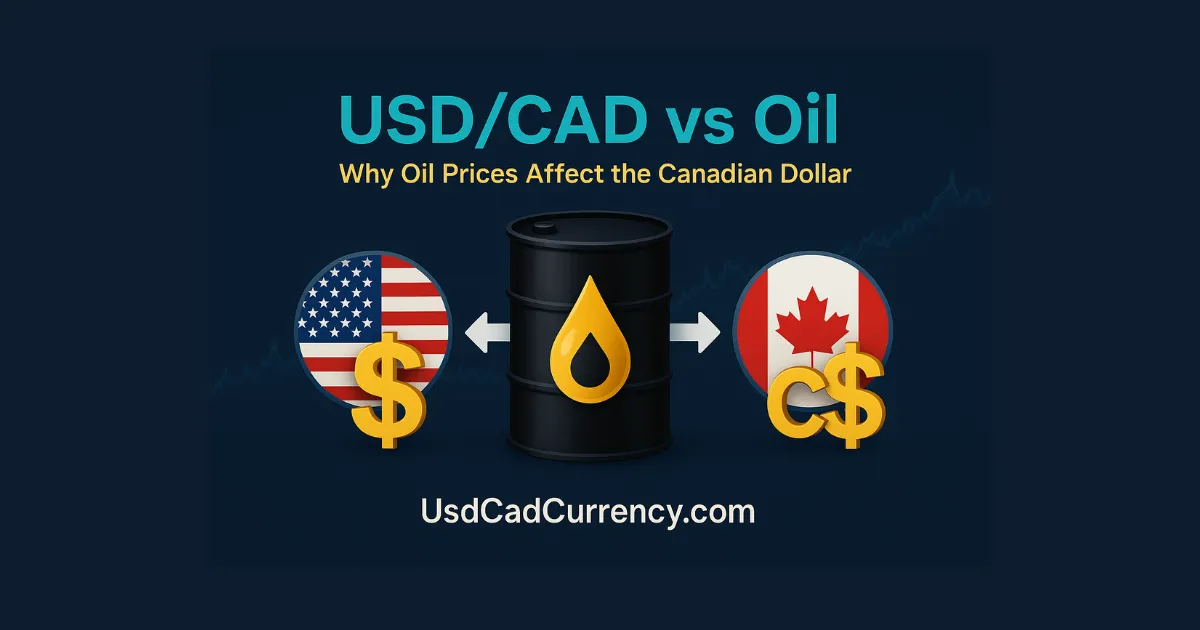
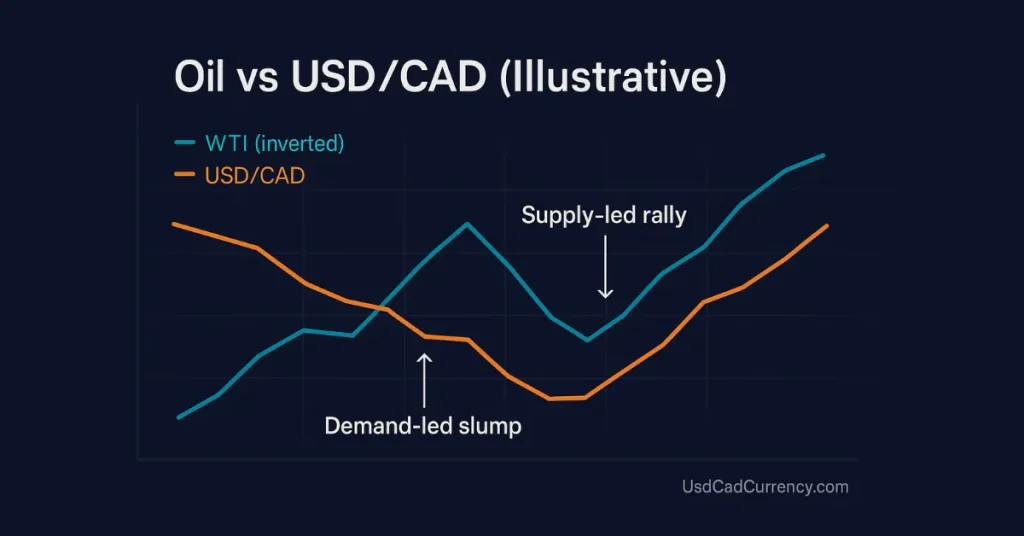
When oil rises → CAD often strengthens (USD/CAD falls) due to export revenue
Canada ranks among the world’s leading crude exporters. When oil prices rise, Canada’s terms of trade improve: export revenues increase, the current account outlook brightens, and foreign demand for CAD-denominated assets can pick up. In FX, that typically means CAD appreciation—so the USD/CAD rate tends to fall (each USD buys fewer CAD). For traders, this is the classic “oil up, CAD up” narrative; for consumers and businesses, a stronger CAD can cheapen USD-priced imports (equipment, software, parts).
When oil falls → terms-of-trade shock can weaken CAD
When oil declines sharply, export receipts shrink and the outlook for energy capex and regional employment softens. Markets often re-price BoC policy (more dovish bias) and growth risks, pushing CAD lower—so USD/CAD rises. Businesses importing USD-priced inputs face higher local costs; exporters with USD revenues but CAD costs may see a temporary margin buffer (natural hedge) but should still plan for demand effects if oil weakness signals slower global activity.
Case studies
Oil shocks and USD/CAD spikes/dips (historical snapshots)
- Supply squeeze / price spike: In past supply disruptions, oil rallied quickly; CAD typically firmed and USD/CAD dipped. The magnitude depended on how broad the risk-off mood was—pure supply tightness favors CAD more than global growth scares.
- Demand slump / price crash: During global slowdowns, oil fell with risk assets; CAD weakened and USD/CAD jumped, especially when markets priced BoC cuts vs Fed holds.
- Mixed regimes: Sometimes oil and USD/CAD de-couple short-term (e.g., flight to USD safety or idiosyncratic Canadian data). These periods remind traders to treat oil–CAD as high, but not static, correlation—regime-dependent and sensitive to policy spreads (Fed–BoC).
Tip: In content or dashboards, label snapshots by regime (“supply-led rally”, “demand-led slump”) so readers don’t over-generalize the correlation.
Turning correlation into decisions
For traders: overlay oil vs USD/CAD to time entries/exits
- Overlay & lead/lag: Plot USD/CAD vs WTI/Brent on the same chart; test a lead of 0–3 days to see if oil moves tend to precede FX in your window.
- Regime filter: Add a rate-differential filter (2-yr UST vs 2-yr GoC). When the Fed–BoC spread widens in favor of USD, the positive oil–CAD link can weaken; when it narrows, oil’s signal often strengthens.
- Event map: Mark EIA/IEA/OPEC releases, NFP, CPI, BoC/Fed dates. Expect volatility clusters; use reduced size, wider stops, or trade post-event pullbacks.
- Risk rules: Keep position size tied to realized volatility (e.g., ATR-based sizing), use disaster stops, and pre-define invalidation if oil and CAD diverge beyond a threshold (e.g., correlation decoupling alert).
For businesses: revenue/cost scenarios vs oil price bands
- Scenario bands: Build P&L views at oil bands (e.g., <$60, $60–80, $80–100, >$100) and map corresponding USD/CAD ranges.
- Natural hedges: Identify USD revenues vs CAD costs (and vice versa). Oil-sensitive exporters often have partial natural hedges; quantify the net exposure before layering financial hedges.
- Hedging cadence: Lock near-term flows with forwards; use options/collars for flexibility around big oil events or policy meetings. Tie hedge ratios to budget rate and order book visibility.
- Pricing playbook: For CAD-priced catalogs, include FX/oil clauses or surcharge tables; for USD-invoiced purchases, negotiate dual-currency quotes or true-up windows to reduce surprise swings.
Want to go deeper? Read our USD/CAD and oil correlation deep dive for regimes, data visuals, and trade/business playbooks.
Policy Drivers — Interest Rates, Inflation, and Central Banks
Fed vs Bank of Canada (BoC)
Rate differentials and carry appeal
The interest-rate spread between the Federal Reserve and the Bank of Canada is a primary macro driver of USD/CAD. When US policy rates—or the expected path of rates—move above Canada’s, USD assets become relatively more attractive, supporting USD strength and pushing USD/CAD higher. When the spread narrows or tilts toward Canada, carry appeal shifts to CAD and USD/CAD tends to drift lower.
Channels to watch: (1) short-dated yields (especially 2-year notes/OIS) that encode policy expectations, (2) credit and financial-conditions indices that amplify or mute rate moves, and (3) term-premium or curve shifts that alter growth/risk narratives beyond the policy rate itself.

Guidance and meeting schedules to watch
Forward guidance can move USD/CAD without an actual rate change. Markets reprice paths on policy statements, press conferences, minutes, and projections. Key items: the Fed’s Summary of Economic Projections and dots, the BoC’s Monetary Policy Report, and any changes in balance-sheet settings or liquidity facilities. Surprise dissent or stronger data-dependence can trigger sharp FX repricing.
Inflation surprises and growth data
US data (NFP, CPI, GDP) vs Canadian data (jobs, CPI, GDP)
Top-tier releases regularly reset yield differentials and drive USD/CAD intraday. In the US, watch NFP and wages, CPI/PCE (especially services ex-housing), GDP, and ISM/PMIs. Hot prints typically lift US yields and push USD/CAD up unless offset by oil or risk sentiment. In Canada, the Labour Force Survey, CPI (trim/median/common), monthly GDP, retail sales, and housing data can pull USD/CAD lower when they narrow the expected Fed–BoC spread.
Market repricing & USD/CAD volatility around releases
Pre-event positioning, options skew, and consensus strength shape the first move. Often there is an initial headline-driven spike followed by a second-leg adjustment as details (revisions, breadth, components) are parsed. Volatility clusters around CPI, NFP, and policy days warrant tighter risk control for traders and careful timing for large corporate conversions.
Where to track policy & macro
Maintain a lightweight dashboard: (1) the Fed–BoC rate differential via 2-year yields and OIS curves, (2) a macro calendar for FOMC/BoC, CPI, NFP, GDP, and oil inventories, and (3) a correlation board for USD/CAD vs oil and yield spreads to spot regime shifts. For deeper background, see our guides on USD/CAD vs interest rates (/guides/usd-cad-vs-interest-rates/), USD/CAD vs inflation (/guides/usd-cad-vs-inflation/), the USD/CAD forecast hub (/forecast/), and Bank of Canada daily references (/guides/bank-of-canada-usd-to-cad/)
Everyday Life — Why USD/CAD Matters to Consumers
How to Transfer Money Between the US and Canada
Fees, FX margins, speed; when to lock a better rate
For cross-border transfers, the all-in cost combines transfer fees, FX margin (the spread on USD/CAD), and delivery speed. Banks tend to charge wider margins and slower settlement; specialist apps often quote tighter FX and same-day delivery. Compare the effective rate (amount received per USD) rather than headline “no fee” claims. Consider locking a rate ahead of payroll, tuition, or invoice deadlines when volatility rises, and avoid weekend conversions when spreads can be wider.
See: Send money US→Canada, Send money Canada→US, Best USD→CAD transfer methods (/guides/best-usd-to-cad-transfer/).
Students & families
Tuition, rent, and living costs conversion
Exchange rate swings directly change the CAD cost of USD-denominated tuition and the USD cost of CAD-denominated rent and living expenses. Build a term budget at several USD/CAD scenarios and set alerts for target rates. Batch larger payments when spreads are tight; for monthly costs, consider scheduled transfers to average rates over time.
See: Study abroad (USD→CAD) (/guides/study-abroad-usd-to-cad/), Cost of living in Canada(/guides/cost-of-living-canada-usd-to-cad/).
Travelers & shoppers
Airport vs ATM vs fintech apps; dynamic currency conversion pitfalls
Airport kiosks typically have the worst USD/CAD rates. ATMs in Canada can be reasonable if your bank refunds fees, but check foreign withdrawal charges. Fintech cards and multi-currency apps often deliver better FX with live interbank-based pricing. Avoid dynamic currency conversion (DCC) at terminals—always choose to be charged in the local currency (CAD) to prevent extra markups.
See: Travel tips for USD→CAD (/guides/travel-usd-to-cad/), Shopping and price parity (/guides/shopping-usd-to-cad/).
Freelancers & remote workers
Getting paid in USD, withdrawing in CAD; minimizing FX costs
If you earn in USD and spend in CAD, minimize FX drag by using multi-currency accounts, collecting in USD, and converting to CAD when spreads are tight or your target rate is hit. Compare payout rails (ACH, wire, e-wallet) and fees; consider partial hedges if invoices are large or frequent. Track your effective USD/CAD across the month to keep margins predictable.
See: Freelancers: USD→CAD guide (/guides/freelancer-usd-to-cad/).
Business & Finance — Managing USD/CAD Exposure
SMEs and importers/exporters
Pricing strategy (USD vs CAD), invoicing currency, buffers
Choose your list currency to align with your cost base and customer expectations. Quoting in USD can simplify supplier alignment and reduce FX surprises for US buyers, but it shifts translation risk to a Canadian P&L. Quoting in CAD improves price stability for local customers yet exposes you to USD input costs. Use explicit FX clauses, review cadence (e.g., quarterly), and small buffer bands around your budget rate to avoid constant repricing. For catalog models, publish surcharge tables for commodity- or USD-linked inputs.
Simple hedging playbook (tenor mix, stop-loss on FX)
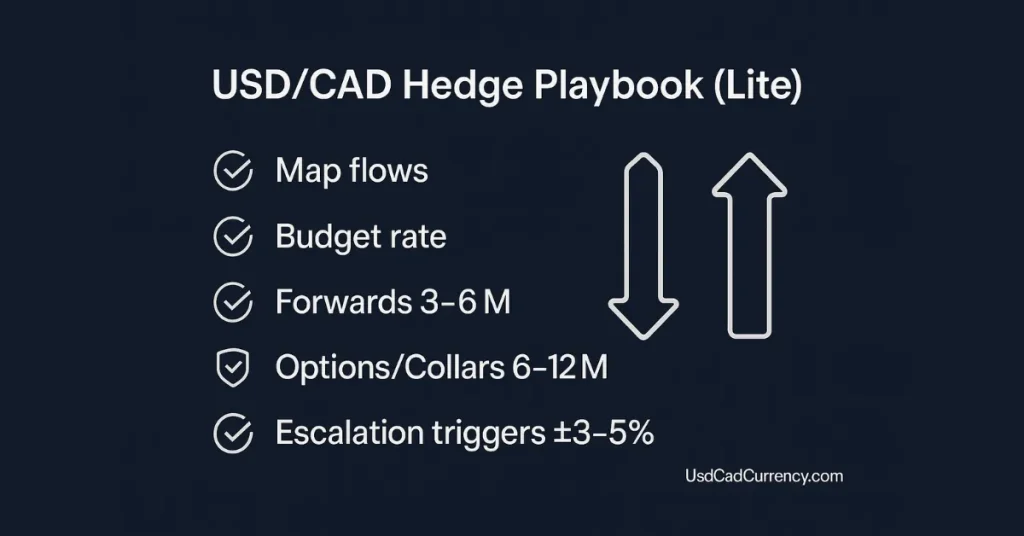
Map monthly USD inflows/outflows and set hedge ratios by tenor: cover the next 3–6 months with forwards (50–80% of forecast), and use options or zero-cost collars for longer tenors to cap tail risk while preserving upside. Define a budget rate and escalation triggers; if spot breaks a threshold, increase coverage or tighten pricing. For operational discipline, maintain a stop-loss on FX (reduce open exposure if moves exceed a preset %), avoid executing large conversions during top-tier data releases, and use multiple providers to compare effective USD/CAD.
Investors & traders
USD/CAD vs equities/commodities (energy, materials)
USD/CAD often co-moves with energy and materials sectors given Canada’s export mix. A stronger CAD (lower USD/CAD) can support Canadian energy producers when oil is rising, while a weaker CAD (higher USD/CAD) can lift CAD-translated revenues for USD-priced commodities but tighten imported equipment costs. For diversified portfolios, monitor how USD/CAD shifts interact with sector tilts, earnings translation, and cross-border ETF exposures.
Correlations to watch (gold, DXY, oil inventories)
Keep a small correlation board: oil benchmarks (WTI/Brent) vs USD/CAD, DXY for broad USD tone, gold for risk/inflation signals, and weekly oil inventory prints for short-term CAD sensitivity. Expect correlations to be regime-dependent—tightest when policy spreads are stable and macro is oil-led, weaker when Fed–BoC repricing dominates.
See also: Stocks & crypto angle (/guides/stocks-crypto-usd-to-cad/), Technical tools for USD/CAD (/tools/technical-analysis-usd-cad/), and Historical data (/guides/historical-data/).
City & Regional Angle — Local Prices, Local Choices
Toronto, Vancouver, Montréal
Rent, groceries, transit passes, insurance—FX sensitivity
Local budgets respond differently to USD/CAD. In Toronto, high housing demand means rent rarely falls with a stronger CAD, but imported goods (electronics, apparel) and some food items can get cheaper when USD weakens. In Vancouver, a gateway for Pacific trade, FX moves filter into grocery categories with large import components and into consumer goods tied to USD pricing. Montréal households feel FX in discretionary retail and travel; insurance and transit passes change more slowly, but equipment and fuel costs tied to USD can pressure operating budgets for transit agencies and service providers.
For residents, the practical approach is to separate sticky costs (rent, insurance, monthly passes) from FX-sensitive baskets (import-heavy groceries, electronics, travel). Time larger purchases when USD/CAD favors CAD strength, compare cross-border e-commerce totals (shipping, duties, returns), and watch seasonal promotions where retailers pass through FX changes. For visitors paying in USD, CAD strength stretches budgets further; for locals shopping in USD online, set alerts and check the effective rate including card and platform fees.
See: City guide hub (/guides/usd-to-cad-cities/).
When USD/CAD Moves — What to Do Right Now
Checklist for individuals
Compare transfer providers, avoid weekend spreads, batch vs drip
Always compare the effective rate (what the recipient actually gets) across banks and specialist apps. Weekend and off-hours conversions often carry wider spreads—schedule transfers on business days where possible. For large payments (tuition, rent, big purchases), consider batching when spreads are tight; for ongoing expenses, drip smaller transfers to average your rate over time. Track fees for cards/ATMs, and prefer local-currency settlement to avoid hidden markups.
Use alerts and set target rates
Set rate alerts for your target USD/CAD so you don’t chase intraday noise. Define a simple ladder (e.g., three target levels) and pre-decide amounts at each trigger. If volatility rises, tighten your ladder or use providers that allow rate locks and scheduled transfers.
See: Best apps for USD→CAD (/guides/best-apps-for-usd-cad/).
Checklist for businesses
Exposure map (revenues, COGS, payroll), hedge policy lite, KPI thresholds
Map monthly USD exposures by category: revenues, COGS, capex, payroll, debt service. Set a basic hedge policy with budget rate, hedge ratios by tenor (near-term forwards, longer-dated options), and clear KPI thresholds (e.g., if USD/CAD moves ±3–5% vs budget, adjust pricing or coverage). Avoid executing large conversions during top-tier data releases; diversify providers to compare all-in rates and settlement speed.
See: Best banks in Canada for USD↔CAD handling (/guides/best-banks-for-usd-cad/)
Data to Watch Weekly — A Simple Monitoring Stack
Macro calendar
NFP, CPI (US/CA), BoC/Fed meetings, oil inventories
Track a weekly calendar of top-tier events. In the US, NFP and CPI/PCE often reset yield expectations and can swing USD/CAD intraday. In Canada, focus on the Labour Force Survey, CPI (trim/median/common), and monthly GDP. Add BoC/Fed meetings, major speeches, and oil inventory reports to anticipate volatility clusters. Note consensus, prior values, and your action plan if results beat or miss.
Market dashboards
Live USD/CAD, oil benchmarks, spreads
Maintain a lightweight dashboard showing live USD/CAD, WTI/Brent benchmarks, and the Fed–BoC 2-year yield spread. Add simple alerts for breakout levels and correlation shifts (e.g., oil rising while USD/CAD fails to fall). Review the board at the start of each trading day and before key releases to align decisions with the prevailing regime.
See: Live USD→CAD rate, USD/CAD forecasts (/forecast/), and Bank of Canada daily references (/guides/bank-of-canada-usd-to-cad/)
FAQs — Why USD/CAD Is Important
Why is USD/CAD sensitive to oil prices?
Canada is a major crude exporter, so higher oil prices improve Canada’s terms of trade and often strengthen the CAD, which tends to push USD/CAD lower. When oil falls, export revenues and energy capex expectations weaken, and the CAD often softens, lifting USD/CAD. The linkage is regime-dependent and can be offset by interest-rate differentials or broad USD risk sentiment.
How do interest-rate changes affect USD/CAD?
The Fed–BoC rate differential is a key driver. When US policy rates (or expectations) rise relative to Canada’s, USD yields become more attractive and USD/CAD tends to move higher. If the spread narrows or tilts toward Canada, carry appeal shifts to CAD and USD/CAD can drift lower. Watch short-dated yields (2-year) and OIS curves for the clearest signal.
Does a stronger CAD help or hurt consumers?
A stronger CAD usually reduces prices for USD-priced imports (electronics, apparel, travel) and can ease inflation pressures. However, export-dependent regions may see slower hiring or thinner margins when CAD is strong. Net impact: consumers who import/spend abroad tend to benefit; communities tied to exports may feel a growth headwind.
What’s the optimal time to exchange USD for CAD?
Convert during liquid market hours (business days, New York–London overlap) to avoid wide spreads, and set target-rate alerts. For large payments, consider batching when quotes are tight; for recurring expenses, drip smaller transfers to average the rate. Avoid weekends/holidays when FX margins can be wider.
Should businesses hedge USD/CAD exposure?
Yes—most firms benefit from a lite hedge policy: map USD inflows/outflows, set a budget rate, cover near-term needs with forwards, and use options/collars for flexibility on longer horizons. Define escalation triggers (e.g., ±3–5% vs budget) and avoid executing large conversions during top-tier data releases.
Conclusion — The Bottom Line on USD/CAD
Strengths & risks
Strengths: deep trade ties, liquid market, informative oil linkage
USD/CAD is anchored by intensive US–Canada trade and supported by deep FX liquidity, making pricing and execution reliable for businesses and traders. Its well-known linkage to oil provides a clear macro signal for timing and risk framing, while established data calendars (NFP, CPI, BoC/Fed) help structure decisions.
Risks: news-driven spikes, policy surprises, oil volatility
Top-tier data and central-bank headlines can trigger sharp, whipsaw moves that overwhelm short-term setups. Policy path surprises (Fed–BoC spread shifts) and abrupt oil swings can break recent correlations, leading to false signals. Plan for volatility clusters, use defined position sizing and invalidation levels, and avoid executing large conversions during major releases.
Follow UsdCadCurrency for weekly USD/CAD insights:
https://www.facebook.com/USDCADCurrency