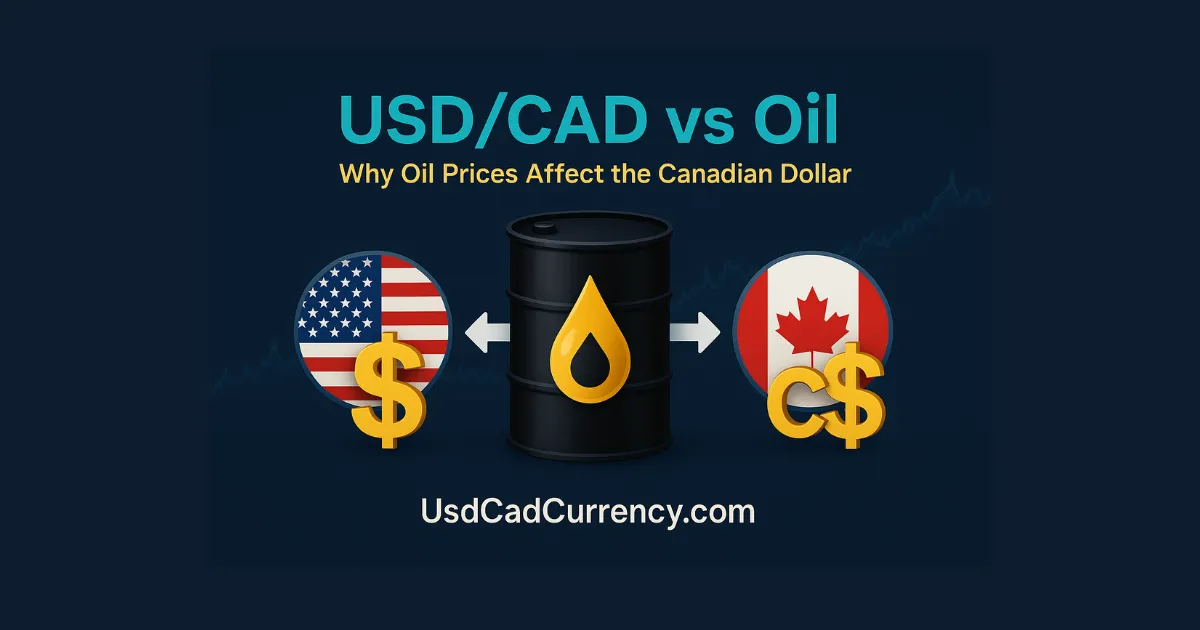
On UsdCadCurrency.com, we closely track the strong connection between oil prices and the USD/CAD exchange rate — one of the most consistent correlations in the forex market. As Canada is among the world’s largest crude oil exporters, the Canadian dollar (CAD) often rises and falls in tandem with oil prices. When oil surges, CAD tends to strengthen, pushing USD/CAD lower; when oil slumps, CAD usually weakens.
Understanding why oil affects the Canadian dollar helps traders anticipate major market swings and identify high-probability trading setups based on this long-standing USD/CAD vs Oil correlation.
Table of Contents
Key Takeaways
- ✅ Oil and CAD have a strong inverse correlation (usually between -0.7 and -0.9).
- ✅ Rising oil prices typically strengthen CAD, pushing USD/CAD lower.
- ✅ Canada’s economy depends heavily on crude exports.
- ✅ Other drivers (interest rate differentials, Fed vs BoC policy) can alter this correlation.
Canada’s Economy and Oil Exports — The Foundation of the Correlation
Canada’s close economic link to the energy sector explains much of the USD/CAD vs Oil correlation. The country is not only a developed economy but also a major commodity exporter, and oil sits at the core of its trade balance. Because crude oil represents a large share of Canada’s export income, fluctuations in oil prices directly influence the Canadian dollar (CAD) through trade flows, capital inflows, and fiscal performance.
Canada as a Major Oil Exporter
Canada consistently ranks among the top five oil-exporting countries in the world, alongside Saudi Arabia, Russia, the United States, and Iraq.
According to data from the International Energy Agency (IEA) and the World Bank, crude oil and refined petroleum products account for roughly 20–25% of Canada’s total exports, a figure that underscores how vital the energy sector is to the Canadian economy.
A substantial portion of this oil flows south: over 70% of Canada’s crude oil exports go to the United States, making the CAD particularly sensitive to both WTI crude prices and U.S. energy demand. When global oil prices rise, Canada’s trade balance tends to improve as export revenues increase, often leading to a stronger Canadian dollar.
📊 Canada’s Oil Export Value by Year (2015–2025)
| Year | Crude Oil Export Value (USD Billion) | % of Total Exports | % of GDP |
|---|---|---|---|
| 2015 | 66.1 | 17.4% | 3.0% |
| 2018 | 86.7 | 21.3% | 3.8% |
| 2020 | 48.9 | 14.9% | 2.2% |
| 2022 | 113.4 | 24.6% | 4.5% |
| 2025* | ~100.0 (est.) | ~22% | ~4.0% |
Data sources: Statistics Canada, World Bank, and EIA estimates.
This table illustrates that whenever oil prices climb, export value and GDP contribution from oil both increase, creating upward pressure on CAD through stronger trade and fiscal metrics.
Oil Revenues Strengthen CAD
When oil prices rise, energy producers earn more in U.S. dollars. These companies and government bodies then convert much of that revenue into Canadian dollars to cover domestic expenses, taxes, and wages.
This increased demand for CAD causes the currency to appreciate.
In addition:
- Higher oil income improves Canada’s fiscal position, giving the government more room for investment and potentially attracting foreign capital.
- The Bank of Canada (BoC) tends to monitor oil closely, as it heavily influences inflation and GDP growth. In periods of sustained high oil prices, BoC often leans toward tighter monetary policy, which further supports CAD strength.
- Conversely, when oil prices fall sharply, corporate profits decline, government revenues drop, and CAD often weakens as a result of lower USD inflows and looser monetary policy.
This mechanism explains why traders frequently treat oil as a leading indicator for USD/CAD: changes in oil prices often precede major moves in the currency pair.
The Inverse Correlation Between Oil Prices and USD/CAD
The Economic Mechanism
When crude oil prices rise, Canada’s export revenues increase, improving the current account and attracting capital inflows. Energy producers typically convert part of their USD earnings into Canadian dollars to cover domestic costs and taxes, boosting demand for CAD. As a result, CAD appreciates and USD/CAD tends to move lower.
Conversely, when oil prices fall, export receipts shrink, fiscal and growth expectations soften, and CAD usually weakens, pushing USD/CAD higher. In short:
- Oil ↑ → CAD ↑ → USD/CAD ↓
- Oil ↓ → CAD ↓ → USD/CAD ↑
This cause-and-effect channel is why traders often treat crude as a lead indicator for USD/CAD.
Historical Correlation Data
Use the chart pack below to visually compare WTI with USD/CAD (inverted) on 1-year and 5-year windows. The table template right after the charts lets you track annual Pearson correlation between daily returns of WTI and inverted USD/CAD (so the sign is intuitive).
📈 Overlay Chart — WTI vs USD/CAD (with invert toggle)
Note: The first widget shows WTI; the second shows USD/CAD and includes an Invert toggle (visual inversion) to mimic the usual opposite movement versus oil. This is a front-end visualization aid; for statistics, compute correlation on returns server-side.
WTI vs USD/CAD (Inverted) — 1Y & 5Y (Static)
d attributes with exported SVG paths from your data pipeline (WTI vs inverted USD/CAD, normalized to the same scale).
📊 Correlation Coefficients by Year (WTI vs USD/CAD — Inverted)
Over time, the correlation between WTI crude oil prices and the inverted USD/CAD pair has remained strongly positive but has started to weaken since 2023.
Historically, higher oil prices have strengthened the Canadian dollar, driving USD/CAD lower, but in recent years, global monetary divergence and USD strength have diluted this relationship.
The table below summarizes the approximate annual correlation levels based on daily return analysis and major macro events.
| Year | Correlation Coefficient | Key Notes |
|---|---|---|
| 2020 | Near zero (lost correlation) | COVID-19 pandemic shock disrupted normal oil-FX linkages |
| 2021 | 0.70 – 0.85 | Global reopening and strong oil rebound boosted CAD recovery |
| 2022 | ≈ 0.90 | Energy price surge following Russia-Ukraine conflict reinforced oil-CAD connection |
| 2023 | 0.40 – 0.50 | USD dominance phase weakened the correlation |
| 2024 | 0.25 – 0.35 | Divergent monetary policies between BoC and Fed reduced sensitivity |
| 2025 YTD | 0.10 – 0.20 | Correlation remains weak; broader macro and energy-transition factors dominate |
🧩 Analysis Summary
- 2020: The traditional correlation collapsed as COVID-19 disrupted global demand and caused extreme oil price volatility.
- 2021–2022: Correlation recovered strongly (above 0.8 – 0.9) during the post-pandemic reopening and energy price surge.
- 2023–2025: The relationship weakened substantially. USD strength, Fed-BoC rate divergence, and structural changes in global energy markets now drive CAD movements more than oil itself.
Forces Diluting the Oil–USD/CAD Relationship:
- USD strength during global risk-off episodes — flight-to-safety flows often override oil-linked moves.
- Monetary policy divergence — differing rate paths between the Bank of Canada (BoC) and the U.S. Federal Reserve.
- Structural energy transitions — growing renewable adoption, pipeline limitations, and refining spreads altering oil’s macro impact.
Historical Examples — When Oil Moved the CAD
The connection between oil prices and the Canadian dollar is not just theoretical — it has repeatedly played out during major market events.
The following historical episodes show how sharp changes in WTI crude prices directly influenced USD/CAD trends.
2014–2016 Oil Crash
Between mid-2014 and early 2016, WTI crude collapsed from around $110 per barrel to $30 — a 70% decline.
As a result, the Canadian dollar plunged, and USD/CAD surged from 1.06 to 1.45, its highest level since 2003.
Falling oil revenues hit Canada’s trade balance, inflation outlook weakened, and the Bank of Canada cut rates twice to cushion the economy.
💡 Lesson: A sustained drop in oil usually drives CAD depreciation, magnified when BoC eases policy.
2020 COVID Oil Collapse
In April 2020, WTI futures briefly turned negative (–$37/barrel) amid a global demand freeze and storage shortage.
The shock sent CAD tumbling, while USD/CAD spiked above 1.45 — levels not seen in years.
The Bank of Canada slashed interest rates to 0.25% and launched quantitative easing, further weakening CAD.
💡 Lesson: During extreme crises, oil’s collapse and global risk aversion combine to strengthen USD/CAD sharply.
2022 Post-War Energy Rally
Following Russia’s invasion of Ukraine, WTI prices surged above $120/barrel, briefly boosting the Canadian dollar.
USD/CAD fell to around 1.25, but the effect proved temporary as USD strength and aggressive Fed tightening later drove the pair higher again.
💡 Lesson: Even when oil rallies, CAD strength can fade quickly if global USD momentum or rate differentials dominate.
📊 Timeline Visual Suggestion
A clean static infographic or SVG chart titled
“Oil Price vs USD/CAD Movements (2014 – 2025)”
should show:
| Year | WTI Trend | USD/CAD Reaction | Notes |
|---|---|---|---|
| 2014–2016 | ↓ $110 → $30 | ↑ 1.06 → 1.45 | Oil crash & BoC cuts |
| 2017–2019 | Stable $45 – $65 | Range 1.25 – 1.35 | Neutral phase |
| 2020 | ↓ to –$37 | ↑ to 1.45+ | COVID oil shock |
| 2021 | ↑ to $75 | ↓ to 1.20 | Recovery phase |
| 2022 | ↑ to $120 | ↓ to 1.25 then ↑ 1.35 | War-driven spike |
| 2023–2025 (est.) | $70 – $85 range | 1.33 – 1.38 | Correlation weakens |
🧠 Key Takeaway
From the 2014 oil crash to the 2022 energy rally, every major move in oil prices has left a clear footprint on USD/CAD.
Yet since 2023, the relationship has become less predictable — oil still matters, but interest-rate policy and global USD flows now play a larger role in driving Canada’s currency.
How Traders Use Oil Prices to Predict USD/CAD Moves
For traders, oil acts as a leading macro indicator for the Canadian dollar.
While the correlation between WTI crude and USD/CAD has weakened since 2023, it still provides valuable directional clues — especially when combined with technical and fundamental analysis.
Monitoring Oil as a Leading Indicator
The first step is to track WTI (West Texas Intermediate) as the benchmark for global oil pricing.
Movements in WTI often lead USD/CAD reversals by hours or days.
- Oil uptrend → potential USD/CAD short bias (CAD strength).
- Oil downtrend → potential USD/CAD long bias (CAD weakness).
- Always confirm with price structure and indicators such as RSI, MACD, or moving averages to avoid false correlations.
💡 Tip: Traders often overlay USD/CAD with inverted WTI charts to visualize short-term divergences.
Divergence Strategy
Sometimes oil and USD/CAD move out of sync — providing trading opportunities.
- If oil prices rise but USD/CAD fails to drop, the pair may be lagging and due for a correction.
- Conversely, if oil falls sharply while USD/CAD stays flat, it may catch up later once the market reprices CAD.
- This correlation reversion strategy can work best when supported by strong fundamentals (e.g., BoC or Fed policy clarity).
💡 Tip: Use correlation divergence as a confirmation filter, not a standalone entry trigger.
Aligning Oil Macro with USD/CAD Charts
The most consistent USD/CAD traders blend macro context with price action setups:
- Track BoC statements, inflation data, and EIA/API oil inventories for real-time sentiment shifts.
- Align oil’s medium-term trend with USD/CAD’s technical structure (trendlines, moving averages, support/resistance).
- Combine macro drivers (oil, yield spreads) with momentum oscillators to time entries during correlation alignment.
📊 Example Setups — Oil vs USD/CAD Reaction
The table below shows how USD/CAD has historically reacted to sharp weekly moves in WTI.
| Scenario | Oil Movement | Typical USD/CAD Reaction | Trader Bias | Notes |
|---|---|---|---|---|
| Strong Oil Rally | +5% in 3 days | USD/CAD ↓ 0.8–1.2% | Short USD/CAD | High correlation phase; CAD benefits from export inflows |
| Oil Correction | –5% in 3 days | USD/CAD ↑ 0.8–1.0% | Long USD/CAD | CAD weakens; often supported by risk-off USD flows |
| Divergence Setup | Oil +5% but USD/CAD flat | USD/CAD ↓ later (lagging move) | Wait for a confirmed breakdown | Good mean-reversion opportunity when correlation reasserts |
| Policy Divergence Phase | Oil steady | USD/CAD ↑ 0.5–1.0% | Long USD/CAD | Fed hawkish, BoC neutral — oil impact secondary |
🧠 Key Takeaway
Oil remains a powerful leading signal for USD/CAD — but it works best when confirmed by technical patterns and macro fundamentals.
At UsdCadCurrency.com, we emphasize using WTI trends alongside interest-rate spreads, volatility measures, and BoC policy tone to build high-probability trade setups in the USD/CAD market.
Other Key Drivers of USD/CAD Beyond Oil
While oil remains a major macro driver for the Canadian dollar, it is far from the only factor shaping USD/CAD trends.
In recent years, interest-rate differentials, economic data releases, and global risk sentiment have often outweighed oil’s influence.
Understanding these drivers helps traders interpret when the traditional oil-CAD link will hold — and when it may fail.
Interest Rate Differentials
The interest-rate gap between the U.S. Federal Reserve (Fed) and the Bank of Canada (BoC) is one of the most powerful long-term forces behind USD/CAD.
- When the Fed raises rates faster than BoC, yield-seeking capital flows into USD assets → USD/CAD rises.
- When BoC is more hawkish, narrowing the rate gap, CAD tends to appreciate → USD/CAD falls.
- Forward guidance and market expectations (e.g., Fed funds futures vs OIS curves) often move USD/CAD ahead of official rate decisions.
💡 Example: In 2024, despite stable oil prices, USD/CAD climbed as the Fed maintained a restrictive stance while BoC signaled possible cuts.
Economic Data Releases
Economic performance indicators regularly move the currency pair even when oil is flat.
Key data to monitor:
- GDP growth — stronger Canadian growth supports CAD; weak output favors USD.
- Inflation (CPI) — drives expectations for BoC tightening or easing.
- Employment figures — higher job gains boost confidence in the CAD.
- Trade balance — surplus tends to strengthen CAD, deficit pressures it.
💡 Tip: Traders often compare release surprises between Canada and the U.S. (e.g., Canada CPI vs U.S. CPI) to gauge directional bias.
Risk Sentiment and USD Dominance
During global risk-off periods, the U.S. dollar tends to strengthen as investors seek safety — even if oil rises.
- Examples include the COVID-19 crash (2020) and banking stress episodes (2023).
- In such environments, USD demand overwhelms oil’s supportive effect on CAD.
- Conversely, in risk-on markets, the Canadian dollar benefits from carry trades and equity inflows.
💡 Rule of thumb: If equity markets and emerging currencies fall together, expect USD/CAD to rise — regardless of oil.
Commodity Complex Effect
Oil isn’t the only resource shaping Canada’s trade balance.
Other commodities — such as natural gas, lumber, copper, and nickel — can reinforce or counterbalance oil’s influence.
- A broad commodity boom usually lifts CAD across the board (the “commodity currency” effect).
- Conversely, when metals and gas prices decline, CAD often weakens even if oil remains steady.
- This diversified exposure explains why CAD’s correlation with oil alone has faded since 2023.
💡 Example: In 2025, strong gold and copper prices partially offset moderate oil gains, keeping USD/CAD range-bound despite stable energy markets.
🧠 Key Takeaway
Oil remains central to understanding USD/CAD, but traders must weigh it alongside monetary policy, macro data, and risk sentiment.
The modern Canadian dollar behaves as a multi-factor currency — driven by a blend of commodities, interest-rate spreads, and global capital flows rather than oil alone.
Has the USD/CAD–Oil Correlation Changed in Recent Years?
The USD/CAD–oil correlation has evolved significantly over the past decade.
While the long-term relationship remains negative (oil up → USD/CAD down), its intensity has weakened as Canada’s economy diversified and global monetary policy began to dominate market pricing.
Declining Sensitivity Since 2019
Since 2019, the Canadian dollar has become less reactive to oil swings.
Two main structural shifts explain this trend:
- Energy diversification:
Canada’s GDP now relies less on crude exports and more on services, manufacturing, and technology sectors.
Non-energy exports (automotive, aerospace, and agriculture) have grown steadily, reducing CAD’s pure oil dependency. - Monetary policy dominance:
Traders increasingly price USD/CAD based on interest-rate differentials, not just oil prices.
With the Fed–BoC policy gap widening after 2022, CAD often moved opposite to oil’s signals — a clear sign of reduced sensitivity.
💡 Example: In 2024, oil hovered near $80–$85 while USD/CAD traded range-bound around 1.36–1.38 due to Fed–BoC divergence.
Short-Term USD/CAD–Oil Correlation Shifts
Despite weaker long-term sensitivity, oil remains a key short-term catalyst for USD/CAD.
- Intraday and weekly reactions to WTI price shocks still influence CAD volatility.
- The rolling 90-day correlation between WTI and inverted USD/CAD has fluctuated from +0.8 in early 2022 to below +0.2 in 2024–2025, illustrating this transition.
- Traders should therefore use oil as a contextual, not primary, input in their trading models.
💡 Tip: In volatile markets (e.g., OPEC announcements, inventory shocks), the oil-CAD link can briefly tighten even when long-term correlation is weak.
📊 Rolling 90-Day Correlation Chart Suggestion
Chart idea:
“WTI vs USD/CAD (inverted) — Rolling 90-Day Correlation, 2020–2025”
| Year | Average 90-Day Correlation | Trend Description |
|---|---|---|
| 2020 | ~0.20 | Disrupted correlation during pandemic volatility |
| 2021 | 0.60–0.75 | Post-COVID recovery phase restored link |
| 2022 | 0.85–0.90 | Peak correlation during global energy crisis |
| 2023 | 0.45–0.55 | USD dominance and policy divergence weaken link |
| 2024 | 0.25–0.35 | Correlation fading despite stable oil |
| 2025 YTD | 0.10–0.20 | Weak, short-lived reactions to oil moves |
📈 Visual suggestion:
A simple line chart (x-axis: 2020–2025, y-axis: correlation coefficient 0.0–1.0)
showing a strong peak in 2022 (~0.9) followed by a steady decline toward 0.2 by 2025.
🧠 Key Takeaway
The USD/CAD–oil correlation still matters — but its role has shifted from a dominant driver to a secondary signal.
In modern markets, interest rates, global USD flows, and risk sentiment often override oil’s influence.
For traders and analysts, oil remains an essential context variable, but not the single compass it once was.
USD/CAD & Oil — Trader/Investor Takeaways
The relationship between oil prices and the Canadian dollar remains one of the most important themes in forex macro analysis.
However, its strength fluctuates with market cycles, rate policies, and global risk sentiment.
For traders and investors, applying oil insights in context is key to staying ahead in the USD/CAD market.
✅ Actionable Takeaways
- Oil remains the single strongest long-term macro driver of the Canadian dollar — but not the only one.
- Monitor correlation strength regularly (e.g., 30D or 90D rolling windows) instead of assuming it’s constant.
- Combine oil trends, interest-rate differentials, and risk sentiment for a more holistic USD/CAD outlook.
- Use oil’s direction as a trade filter — rising oil supports CAD (bearish USD/CAD bias); falling oil supports USD (bullish USD/CAD bias).
- Always validate with technical confirmation, such as RSI, MACD, or key support/resistance zones.
📈 Pro Tip for UsdCadCurrency Readers
On UsdCadCurrency.com, traders can:
- View the live USD/CAD vs WTI correlation chart in real time.
- Access our USD/CAD converter and oil impact dashboard for quick sentiment analysis.
- Track rate differentials and oil inventory reports (EIA/API) directly within our analytics tools.
👉 Stay updated: The oil–CAD relationship evolves with every rate decision and macro event — revisit it monthly to keep your edge.
USDCADCurrency – Common Questions & Answers
Does higher oil price always strengthen CAD?
Usually yes — higher oil prices boost Canada’s export revenues and support the Canadian dollar. However, the effect can be offset by global USD demand, risk aversion, or central bank policy. During global “flight-to-safety” periods, the USD may rise even when oil climbs.
Which oil benchmark affects CAD the most?
The key benchmark is WTI (West Texas Intermediate), as Canada’s crude exports are priced relative to North American markets. While Brent influences global sentiment, WTI is more directly linked to USD/CAD movements.
Can traders use oil prices to forecast USD/CAD?
Yes — traders often use oil as a leading macro indicator for CAD strength or weakness. Although the correlation is not perfect, tracking WTI trends, interest-rate spreads, and risk sentiment helps form a more accurate USD/CAD trading bias and improves risk management.
🧭 Final Thought
Oil will continue shaping CAD’s long-term path, but the modern market requires a multi-factor perspective.
At UsdCadCurrency.com, we help traders navigate that complexity — combining live USD/CAD rates, oil analytics, and macro insights to make data-driven trading decisions.
Stay Ahead with Real-Time USD/CAD & Oil Insights
The USD/CAD–oil relationship is constantly evolving — shaped by energy prices, rate policy, and market sentiment. Follow USDCADCurrency on Facebook to get real-time updates, chart insights, and macro analysis that help you trade smarter every day.
📊 Daily highlights • 🛢 Oil–CAD analysis • 💡 Trading perspectives